You’ve just finished dinner and loaded the dishwasher. You select the cycle, press start, and walk away, confident that you’ll return to perfectly clean, dry dishes. But when the cycle ends, you open the door to a frustrating sight: a tub full of wet, dripping dishes. If your Whirlpool dishwasher is not drying dishes, you’re not alone. This is a common problem. The good news is, most of the time, the solution is easier than you think. You can often fix it yourself.
Let’s dive into the most common reasons your Whirlpool dishwasher is leaving dishes wet. We’ll cover everything from simple user errors to part failures. Follow along, and you’ll get your dishes back to being cupboard-ready in no time.
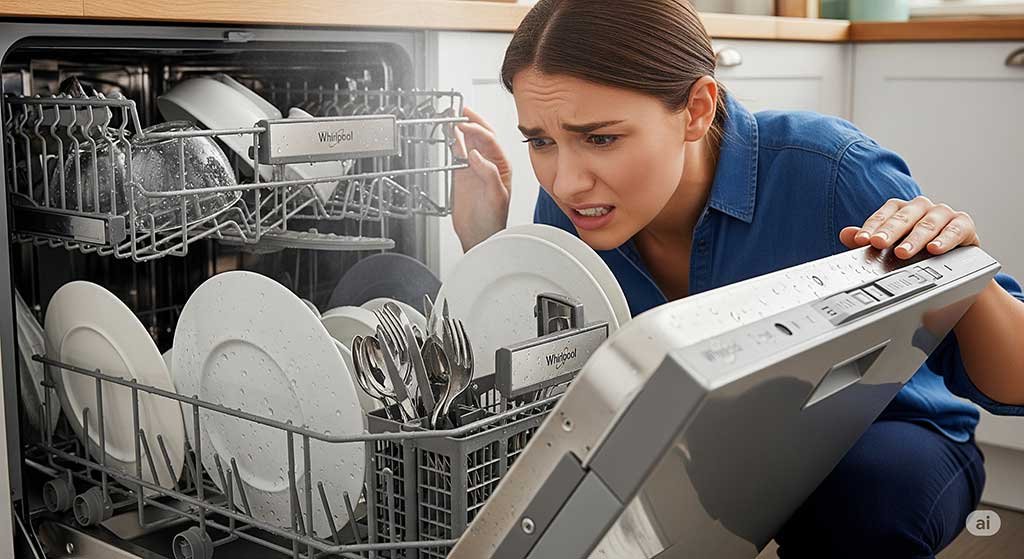
Table of Contents
How to Fix Whirlpool Dishwasher Not Drying Dishes Issue
Sometimes, the issue isn’t a broken part. It’s how you’re using the dishwasher. Before you get out any tools, check these simple things first.
Are You Using Rinse Aid?
This is the most frequent reason for poor drying. Rinse aid is not just for shine. It’s a crucial part of the drying process. It works by reducing the surface tension of the water. This allows water to slide off your dishes in sheets instead of forming droplets. Without rinse aid, those droplets cling to dishes, especially plastics, and don’t evaporate properly.
- Check the dispenser: The rinse aid dispenser is usually a small compartment on the inside of the door, right next to the detergent cup.
- Refill it: If the indicator shows it’s empty, refill it. The fluid should last for a while, but it’s important to keep it topped up.
- Adjust the setting: Many dishwashers have an adjustable setting for rinse aid. If your dishes are still wet, you might need to turn up the dosage.
How Are You Loading Your Dishes?
Your dishwasher needs proper airflow to dry dishes. A cluttered dishwasher traps moisture. Hot air can’t circulate freely.
- Don’t overcrowd: Leave space between each dish. Don’t stack plates too close together.
- Avoid nesting: Make sure spoons and forks aren’t stuck together. This creates “pockets” where water gets trapped.
- Tilt items: Place bowls, cups, and mugs upside down at a slight angle. This prevents water from pooling in the bottom.
- Plastics go on top: Plastic items don’t hold heat well. They almost always come out with water drops. Place them on the top rack to keep them away from the heating element.
Did You Pick the Right Drying Cycle?
Your Whirlpool dishwasher has different cycles. Not all of them include a heated dry.
- Check your settings: Make sure you’ve selected a cycle that uses a heated dry. It might be labeled as “Heated Dry” or “ProDry.”
- Air-dry modes: If you use an “Eco” or “Air-Dry” option, the dishwasher won’t use a heating element. This saves energy but will leave dishes wetter.
- Door Open Dry: Some modern Whirlpool models have a “Door Open Dry” or “Natural Dry” feature. The door opens slightly at the end of the cycle to let steam escape. Make sure this option is selected if you want it to work.
When Parts Are the Problem
If you’ve checked the basics and your dishes are still not drying, a faulty part might be to blame. This is where you might need to do a little more work.
The Heating Element
The heating element is a large, circular component at the bottom of the dishwasher tub. It heats the water during the wash cycle and then heats the air during the dry cycle. A failed heating element is a very common reason for a Whirlpool dishwasher not drying dishes.
Signs of a faulty heating element:
- Dishes are cold and wet after the cycle.
- The element looks burnt or discolored.
- There’s no heat inside the dishwasher during the drying cycle.
How to check it:
You can test the heating element with a multimeter. First, disconnect the power to your dishwasher. Unplug it from the wall or turn off the circuit breaker. Locate the heating element. Check for continuity. If your multimeter shows a reading of zero or infinity, the element is likely bad and needs to be replaced.
The Vent Assembly
Many Whirlpool dishwashers use a vent to release steam and moisture. Some models have a fan to help push the moist air out. If the vent is blocked or the fan is broken, the steam gets trapped inside, leaving your dishes wet.
How to check it:
- Look for blockages: Check the vent for any debris or obstructions.
- Listen for the fan: Some models have a vent fan. If you don’t hear a fan running at the end of the cycle, the motor might have failed.
- Test the motor: You can use a multimeter to test the vent fan motor for continuity, just like with the heating element.
The High-Limit Thermostat
This is a safety device. It stops the heating element from getting too hot. If the thermostat fails, it could cut off the power to the heating element too early. This stops the drying cycle before it’s finished.
How to check it:
Like other parts, you can test the thermostat with a multimeter. Make sure the power is off. The thermostat should have continuity at room temperature. If it doesn’t, it’s faulty and needs to be replaced.
Common Problems and Solutions
Problem | Cause | How to Fix It |
Dishes are wet and cold | No heated dry selected | Use the “Heated Dry” or a similar cycle. |
Water spots remain | No or insufficient rinse aid | Fill the rinse aid dispenser and check the dosage setting. |
Dishes are dripping | Improper loading | Load dishes with space between them. Avoid stacking and nesting. |
Dishwasher isn’t getting hot | Failed heating element | Test the heating element with a multimeter. Replace it if it’s bad. |
Moisture is trapped inside | Blocked or failed vent | Inspect the vent for blockages. Test the vent fan motor. |
Cycle ends with wet dishes | Faulty thermostat | Test the high-limit thermostat. Replace if it has no continuity. |
Dishes come out spotty | Hard water issues | Use rinse aid to help water bead and drain. |
Plastic items are wet | Material doesn’t hold heat | This is normal. You can hand-dry plastics if you need them completely dry. |
More Advanced Issues: Control Board and Sensor
If you’ve gone through the basic checks and parts, and nothing seems to be working, the problem could be with the dishwasher’s main “brain.”
- Control Board: The main electronic control board tells all the other parts what to do. If a relay on the board fails, it might not send power to the heating element or vent fan. This is a complex repair, and it’s best to call a professional.
- Turbidity Sensor: Some modern Whirlpool models have a turbidity sensor. This sensor measures how dirty the water is. If it’s faulty, it might not signal the dishwasher to go into a full wash or drying cycle. This can lead to wet dishes. A professional can diagnose this issue.
FAQ
Yes, it is very normal. Plastic does not retain heat like glass or ceramic. This means water droplets don’t evaporate as easily. If you want plastics to be completely dry, you may need to hand-dry them.
Yes. Excessive suds can interfere with the washing and rinsing process. The bubbles can stop the water from reaching all the dishes. They can also create a residue that makes it hard for rinse aid to work properly.
A white film can be a sign of hard water. It can also mean you’re using too much or too little detergent. Adjusting your detergent and rinse aid usage can help. Using a dishwasher cleaner regularly can also prevent mineral buildup.
Many dispensers have a small indicator window. The window will be clear or dark when it’s empty. It will be colored when it’s full. Check your user manual for the specific indicator on your model.
First, turn off the power. Remove the dishwasher’s access panel. Disconnect the wires from the heating element. Set your multimeter to the Rx1 setting. Touch one probe to each terminal of the element. You should get a reading between zero and infinity. If the reading is exactly zero or infinity, the element is likely bad.
A heated dry cycle does use more electricity than an air-dry cycle. However, modern dishwashers are very efficient. The cost is usually only a few cents per load. The convenience of having dry dishes is often worth the small cost.
You should call a professional if you’ve tried all the simple fixes and your dishwasher still isn’t working. If you suspect a broken heating element, control board, or sensor, a technician has the right tools and expertise to safely diagnose and fix the problem.
Bottom Line
Having a Whirlpool dishwasher not drying dishes is a hassle. But with a little knowledge, you can often solve the problem yourself. By checking your rinse aid, adjusting your loading habits, and troubleshooting a few key parts, you can get your machine back to its best. Don’t let soggy dishes ruin your day. With these tips, you’ll be on your way to gleaming, dry dishes every time.