You know that dread. You stand in front of the mirror, razor in hand, bracing yourself for the inevitable red bumps, burning sensation, and irritation that follows your morning routine. If you have sensitive skin, shaving isn’t just a chore; it’s a battle. You’ve probably heard that electric shavers are the answer, but then you’re hit with the confusing dilemma: Foil vs Rotary shaver for sensitive skin—which one is actually going to save your face?
Choosing the wrong tool can leave your neck looking like a strawberry field, while the right one can turn shaving into the smooth, comfortable ritual it’s supposed to be. In this guide, we aren’t just comparing specs; we are breaking down exactly how these two technologies interact with your delicate skin so you can finally make a choice that doesn’t hurt.
Before we declare a winner, you need to understand what you are actually putting on your face. The difference isn’t just cosmetic; it’s mechanical.
What is a Foil Shaver?
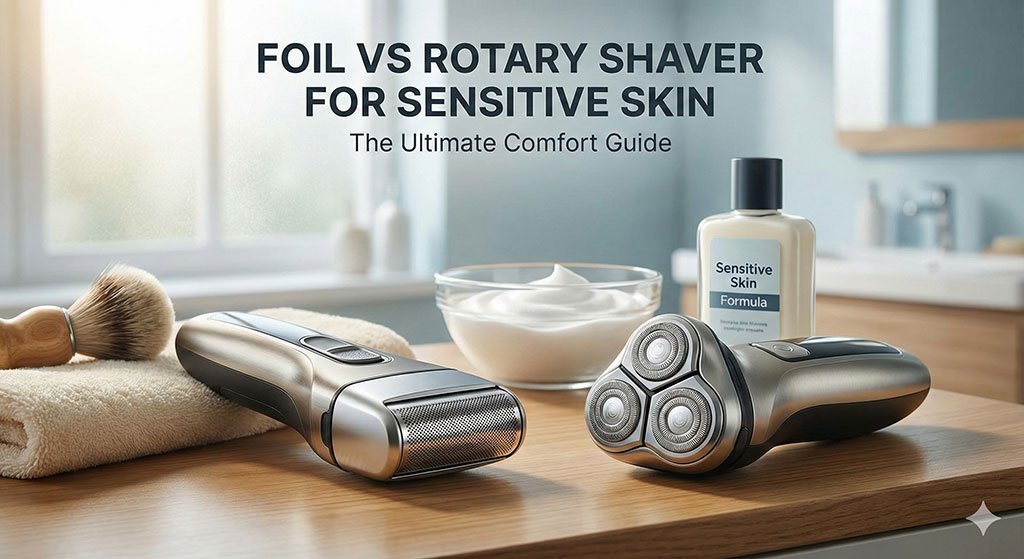
Picture a traditional safety razor, but electrified. A foil shaver features a straight head with oscillating blades (cutters) that move back and forth at incredible speeds. These sharp blades are hidden behind a thin, perforated metal sheet called a “foil.”
The magic happens when you glide the shaver in straight lines. The foil catches your hair through the holes, and the blades slice them off without ever touching your skin directly. This barrier is the foil shaver’s secret weapon for comfort.
What is a Rotary Shaver?
Rotary shavers look entirely different. They typically have three circular heads that flex and pivot independently. Inside each head, circular blades spin rapidly.
You use this tool in circular motions, massing it over your face. The design allows the shaver to conform to the unique curves of your chin, jawline, and neck. It’s built to tackle hair that grows in wild, different directions.
Foil vs Rotary Shaver for Sensitive Skin: Core Comparison
When your skin reacts to everything, the mechanics of the cut matter more than anything else. Here is how they stack up specifically for your sensitive skin needs.
1. The Protection Factor
Foil shavers are widely considered the gold standard for sensitive skin. Why? The foil itself acts as a physical guard. It separates the sharp cutting elements from your epidermis. When you press a foil shaver against your face, the foil depresses slightly, but the blades remain safely behind the mesh. This minimizes friction and significantly reduces the chance of razor burn.
Rotary shavers, while effective, often require you to press slightly harder and use circular rubbing motions. For tough skin, this is fine. But for sensitive skin, that repetitive circular friction can over-exfoliate and irritate, leading to redness.
2. The Heat Issue
Friction creates heat, and heat is an enemy to sensitive skin. Because foil shavers use straight, efficient strokes, they tend to generate less heat on the skin’s surface compared to the rotary style. Rotary shavers, due to the spinning nature and the circular application method, can sometimes warm up the skin more, which might trigger inflammation if you take too long to shave.
3. Cutting Proximity
Foil shavers are designed to get extremely close to the skin—often closer than rotaries. Paradoxically, a closer shave can sometimes be better for sensitive skin because it means you don’t have to go over the same spot multiple times. One efficient pass with a quality foil shaver often does the job.
Comparison at a Glance
To make this easier for you, here is a quick breakdown of how these two heavyweights compare.
Feature | Foil Shaver | Rotary Shaver |
Motion | Straight, linear strokes | Circular, rotating motions |
Skin Protection | High (Foil acts as a barrier) | Moderate (Dependent on pressure) |
Best For Hair Type | Fine to medium, straight hair | Coarse, thick, curly hair |
Contour Adaptation | Low to Medium | High (Excellent for jawlines) |
Noise Level | Louder (High-pitched buzz) | Quieter (Low hum) |
Cleaning | Easy (Pop off head and rinse) | Complex (Disassemble heads) |
Sensitive Skin Rating | Excellent | Fair to Good |
When to Choose a Foil Shaver
You should lean towards a foil shaver if:
- You shave every day: Foil shavers excel at cutting short stubble. If you are a daily groomer, this tool is efficient and gentle.
- You have fine hair: If your beard isn’t made of steel wire, the foil shaver will glide effortlessly.
- You need precision: Trying to style sideburns or a goatee? The straight edge of a foil shaver gives you exact lines that a rotary circle just can’t match.
- Your skin is easily irritated: If you are prone to razor bumps (pseudofolliculitis barbae), the linear cutting action reduces the tugging that causes them.
When to Choose a Rotary Shaver
Don’t count the rotary out completely. It might be your best bet if:
- You have tough skin: If your skin isn’t hyper-sensitive but you have a very thick beard, rotary power might be necessary.
- You shave irregularly: If you skip shaving for 3-4 days, long hairs can poke through a foil mesh and get missed. Rotary shavers are fantastic at scooping up longer, flat-lying hairs.
- You have complex contours: If you have a sharp jawline or a prominent Adam’s apple, a foil shaver might miss spots. A rotary shaver flexes around these obstacles effortlessly.
- Your hair grows in circles: If your neck hair looks like crop circles, a rotary shaver’s multi-directional cutting is more effective at capturing it.
Pros and Cons of Foil Shaver & Rotary Shaver
Foil Shavers
- Pros:
- Closest electric shave possible.
- Gentle on skin due to the foil barrier.
- Easy to clean and maintain.
- Great for detailing and edging.
- Cons:
- Can be noisy.
- Struggles with long hairs (3+ days of growth).
- Requires manual maneuvering around curves.
Rotary Shavers
- Pros:
- Handles long, coarse hair well.
- Quiet operation.
- Adapts to facial shapes automatically.
- Catches hair growing in different directions.
- Cons:
- Circular motion can irritate sensitive skin.
- Doesn’t shave as close as foil.
- Harder to clean thoroughly.
Secret to an Irritation-Free Shave
Regardless of whether you pick Foil vs Rotary shaver for sensitive skin, your technique is 50% of the battle. Even the most expensive foil shaver will chew up your face if you use it dry on unwashed skin.
1. Prep is Everything
Never shave cold. Wash your face with warm water to soften the hair cuticle and open up your pores. If you have extremely sensitive skin, use a pre-shave oil. This adds a layer of lubrication that allows the shaver to glide rather than drag.
2. Wet vs. Dry Shaving
Most modern electric shavers are “Wet/Dry.” Use this to your advantage. Shaving dry is convenient, but shaving wet—with a high-quality shaving gel or cream—is a game-changer for comfort. The foam creates a cushion that drastically reduces friction.
3. The 3-Minute Rule
Try to finish your shave efficiently. The longer you run a motor over your face, the hotter the device gets, and the more irritated your skin becomes. If you miss a spot, don’t keep grinding away at it. Re-lather or come back to it later.
4. Post-Shave Care
Rinse with cold water immediately to close the pores. Pat your face dry—never rub. Follow up with an alcohol-free aftershave balm. Alcohol dries out the skin and causes stinging; a balm hydrates and soothes.
FAQ
For beginners, a foil shaver is generally the better choice. The technique (straight strokes) mimics a traditional razor, making it intuitive to learn. More importantly, the foil barrier offers a “safer” feel that prevents you from applying too much pressure, which is a common mistake that leads to irritation.
Yes, absolutely! Provided your model is labeled “Wet/Dry” or waterproof. Using shaving cream adds significant lubrication, which is highly recommended for sensitive skin. It helps the shaver glide smoothly and prevents the “tugging” sensation that dry shaving can sometimes cause.
Dull blades are a primary cause of razor burn because they pull hair instead of cutting it. For foil shavers, replace the foil and cutter block every 12 to 18 months. For rotary shavers, replace the rotating heads every 12 months. If you shave daily or have very coarse hair, you may need to replace them sooner.
Yes, there is an “adjustment period.” When you switch from manual razors to electric, or from foil to rotary, your skin may break out or feel tender for the first 2-3 weeks. This is normal. Your skin needs time to adjust to the new method of hair removal. Stick with it for at least a month before giving up.
Foil shavers are typically better for preventing ingrown hairs. Because they cut hair straight across and slightly above the skin line (thanks to the foil guard), the hair is less likely to curl back under the skin. Rotary shavers, which use a lifting motion, can sometimes cut hair too deep or at an angle, increasing the risk of ingrowns.
Actually, rotary shavers are often preferred for head shaving. The contours of the skull are difficult for a straight foil head to navigate effectively. The flexible heads of a rotary shaver conform perfectly to the curve of your head, making the process faster and easier.
The neck is the most sensitive area for most men, and hair there often grows flat and in swirling patterns. Even with a foil shaver, you must map your grain. Shave against the grain for closeness, but if irritation occurs, try shaving with the grain first. Also, ensure you aren’t pressing too hard; let the weight of the shaver do the work.
Bottom Line
When deciding on Foil vs Rotary shaver for sensitive skin, the foil shaver is the clear winner for most men. Its protective barrier and linear motion offer a gentler, closer shave with less friction. However, if you have tough skin and erratic growth patterns, a rotary might still serve you well. Choose the tool that fits your specific hair type and comfort needs.