Are your morning shaving sessions leaving you with painful nicks and irritating razor burn? Choosing the right grooming tool is the most important step for a flawless routine. When debating adjustable vs. fixed safety razors, the right choice depends heavily on your experience level and beard type.
Both styles offer a massive upgrade over disposable cartridge razors. They provide a much closer shave and significantly reduce plastic waste. However, the internal mechanics and blade exposure differ completely. Understanding these core differences will save your skin and your wallet.
In this comprehensive guide, we will break down the engineering behind both razor types. We will explore blade gaps, aggression levels, and maintenance requirements. By the end, you will know exactly which traditional razor deserves a spot on your bathroom counter.
Table of Contents
What Is a Fixed Safety Razor?
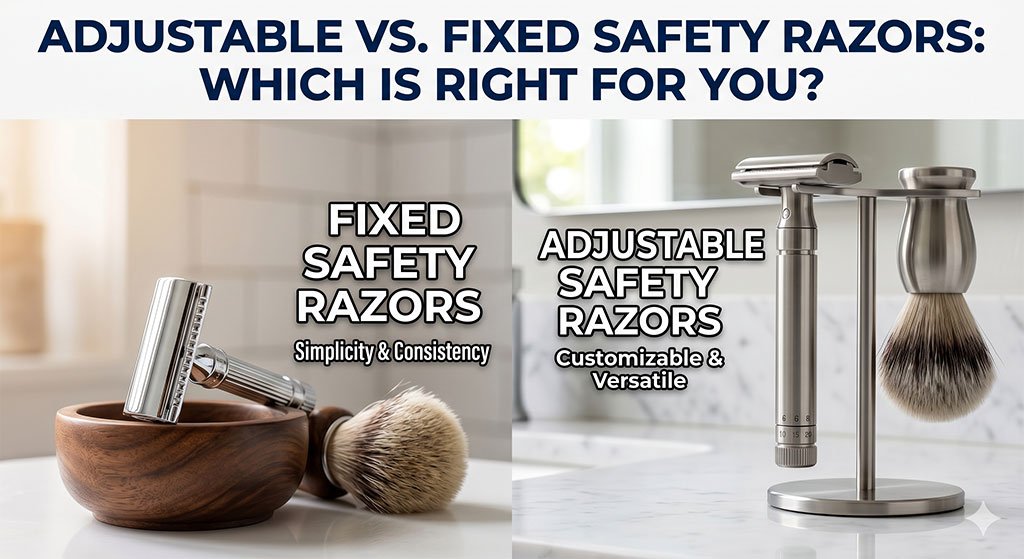
A fixed safety razor is the classic standard of traditional wet shaving. It features a design where the blade gap and blade exposure are permanently machined into the solid metal. Once you load the double-edge blade and tighten the handle, the settings cannot be changed.
This permanent setting means the razor has a single, consistent level of aggression. Manufacturers design these razors in mild, medium, or aggressive profiles. If you buy a mild fixed razor, it will always remain a mild razor, regardless of how you hold it.
Because there are no moving parts, a fixed safety razor is incredibly durable. Most models are constructed from solid brass, zinc alloy, or stainless steel. They often come in classic two-piece or three-piece designs that can easily last a lifetime with minimal maintenance.
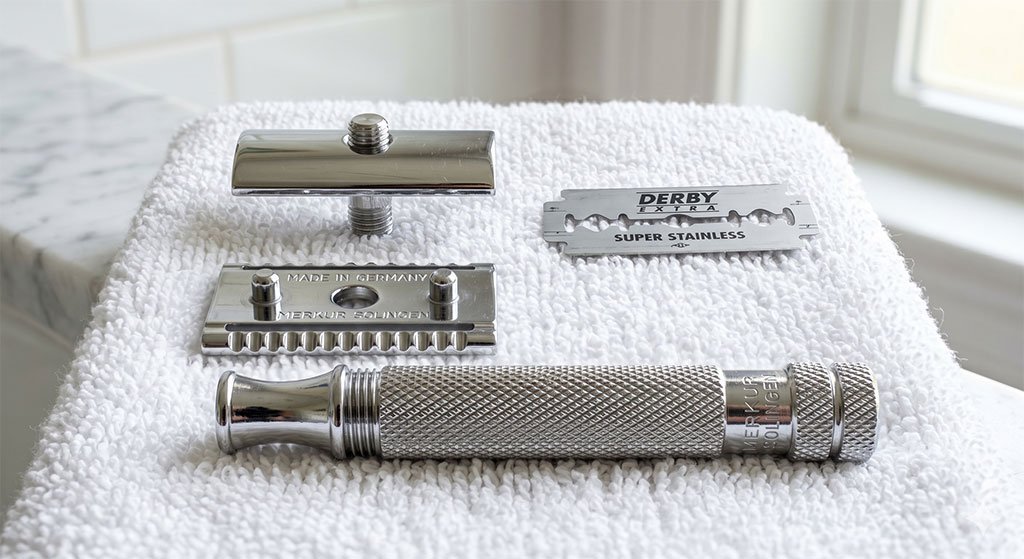
Fixed razors are widely recommended as the absolute best starting point for beginners. The unchangeable blade gap forces you to focus entirely on improving your manual shaving technique. You learn the crucial skill of maintaining a 30-degree shaving angle without mechanical distractions.
What Is an Adjustable Safety Razor?
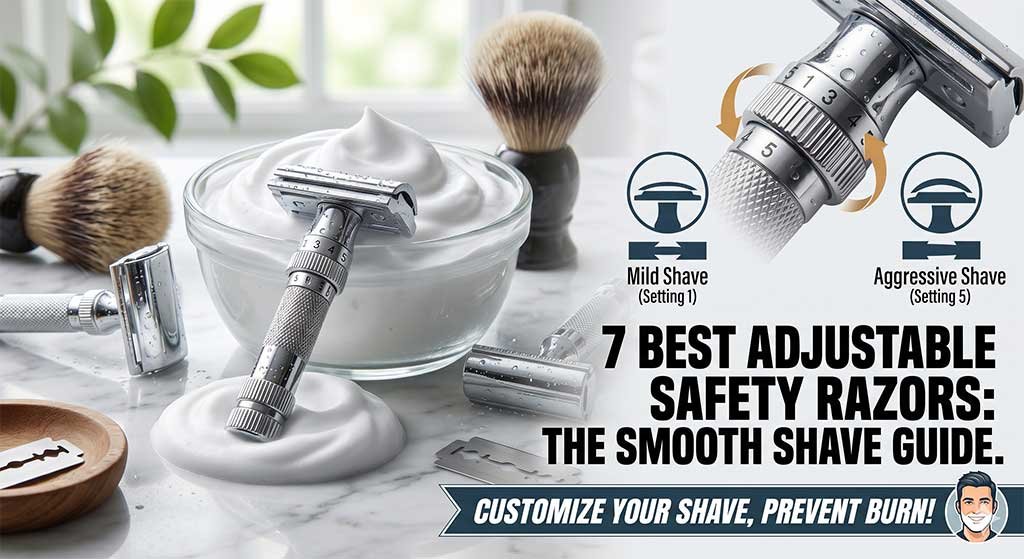
An adjustable safety razor introduces mechanical customization into your daily shaving routine. It features a built-in mechanism, usually a numbered adjustment dial located near the base of the handle. Turning this dial physically raises or lowers the base plate inside the razor head.
By moving the base plate, the razor actively changes the gap between the safety bar and the blade. A low setting (like a 1 or 2) creates a very narrow gap. This results in a mild, forgiving shave that is perfect for highly sensitive skin.
Conversely, turning the dial up to a higher setting (like a 5 or 6) significantly increases the blade exposure. This aggressive setting exposes more of the sharp edge. It is incredibly effective for effortlessly mowing through several days of thick, dense beard growth.
This on-the-fly customization is the biggest selling point of the adjustable design. You can use a highly aggressive setting for your first pass going with the grain. Then, you can easily dial it down to a mild setting for a smooth, against-the-grain pass on your neck.
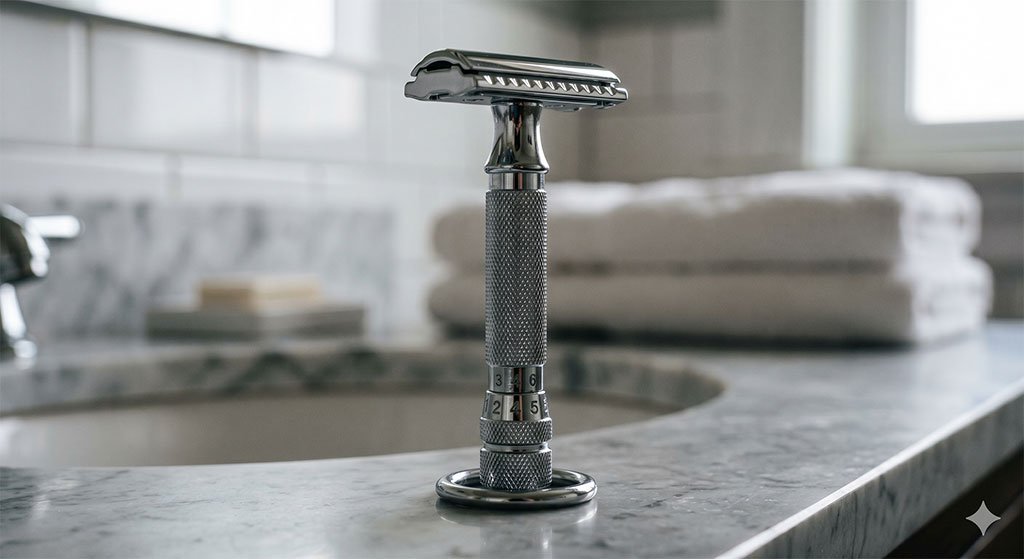
Head-to-Head Comparison: Adjustable vs. fixed safety razors
When comparing adjustable vs. fixed safety razors, laying out the specifications side-by-side reveals clear distinctions. The table below highlights the fundamental mechanical differences between the two grooming tools to help you make an informed decision.
Feature | Fixed Safety Razor | Adjustable Safety Razor |
Blade Gap | Permanent / Machined | Variable / Dial-controlled |
Learning Curve | Low / Very Beginner Friendly | Moderate to High |
Moving Parts | Few to None | Multiple Internal Springs |
Price Point | Generally Lower ($15 – $50) | Generally Higher ($50 – $200+) |
Head Profile | Compact and Nimble | Often Bulkier / Thicker |
Maintenance | Simple Rinse and Wipe | Requires Deep Cleaning |
Durability | Extremely High (Lifetime) | Good, but Springs Wear Out |
As the table illustrates, simplicity is the main advantage of the fixed design. The lack of moving parts ensures longevity and ease of use. However, the adjustable models offer unparalleled versatility that a static shaving tool simply cannot match.
Deep Dive: Pros and Cons of Each Type
Every shaving tool has its own unique strengths and weaknesses. Understanding these pros and cons will help you match the razor to your specific skin type and grooming habits. Let us explore the benefits and drawbacks of both styles.
Fixed Safety Razors: The Pros
- Highly Affordable: You can find premium, well-machined fixed razors for a fraction of the cost of complex adjustable models.
- Incredible Durability: With zero internal springs or calibration dials, there is practically nothing that can break or malfunction over time.
- Excellent for Beginners: The consistent blade exposure allows new wet shavers to build muscle memory and perfect their shaving angle quickly.
- Nimble Head Design: The compact top cap makes it much easier to shave tight areas, like directly under the nose.
Fixed Safety Razors: The Cons
- Zero Versatility: If your hair grows out over a long weekend, a mild fixed razor might struggle to cut through the bulk efficiently.
- Trial and Error: You might have to buy two or three different fixed razors before you find the exact aggression level that suits your skin.
Now, let us examine the more complex alternative. The adjustable razor is often considered the holy grail by experienced wet shaving enthusiasts. Here is why they love it, along with a few common complaints.
Adjustable Safety Razors: The Pros
- Ultimate Customization: You can precisely tailor the shave to match your hair growth, skin sensitivity, and the specific area of your face.
- Multi-Pass Efficiency: Dial up for an aggressive first pass to remove bulk, then dial down for a gentle, irritation-free final pass.
- All-in-One Solution: It essentially gives you six or more different razors housed within a single handle, saving space in your bathroom cabinet.
Adjustable Safety Razors: The Cons
- Higher Initial Investment: Quality adjustable razors require precise engineering, which significantly drives up the manufacturing and retail costs.
- Maintenance Required: Soap scum and hard water deposits can jam the internal springs, requiring regular soaking and deep cleaning.
- Bulky Razor Head: The internal mechanics require a thicker base plate, making it slightly more difficult to maneuver around tight facial contours.
Shaving Technique: How to Choose the Right Razor for Your Shave
Selecting the perfect razor is highly subjective. It depends entirely on your personal grooming habits, how often you shave, and the sensitivity of your skin. Let us look at a few common shaving scenarios to help you decide.
Scenario 1: You are a complete beginner.
If you are transitioning from modern cartridge razors, start with a fixed safety razor. The learning curve for traditional grooming is already steep. A mild fixed razor removes the temptation to constantly tweak settings, forcing you to learn proper technique.
Scenario 2: You suffer from highly sensitive skin.
If your neck is prone to severe razor bumps, an adjustable razor is an excellent investment. You can use a standard setting for your cheeks, then dial it all the way down to a mild, forgiving setting for your sensitive neck area.
Scenario 3: You only shave once or twice a week.
Weekend shavers deal with significant hair growth. A mild fixed razor will clog and tug at long hairs. An adjustable razor allows you to open the blade gap completely, effortlessly slicing through heavy stubble on the first pass.
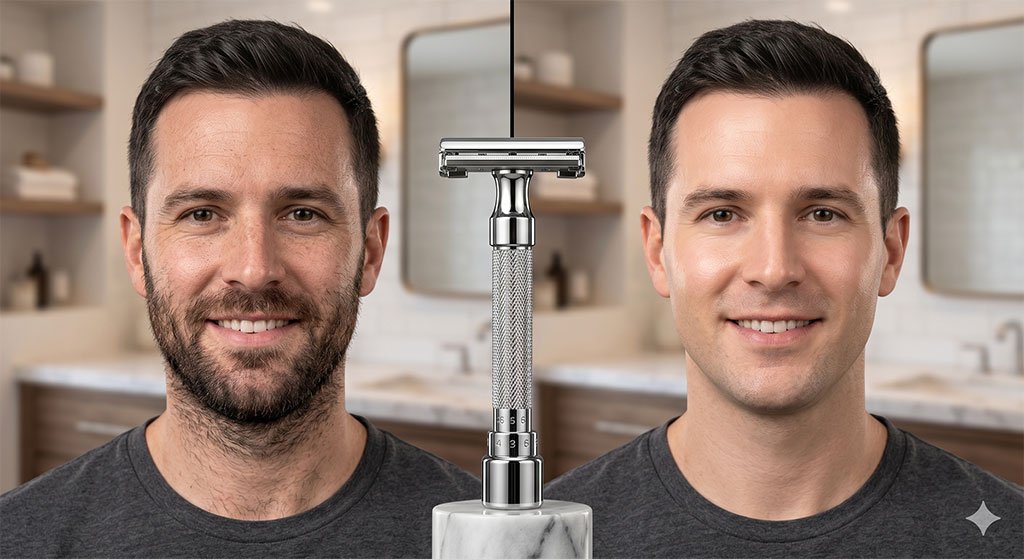
Blade Pairing: Matching Your Blade to Your Razor Type
Your choice of double-edge blade plays a massive role in how your razor performs. When using a fixed safety razor, finding the perfect blade is crucial. Because you cannot adjust the razor’s aggression, you must rely entirely on the sharpness of the blade.
For a mild fixed razor, experienced shavers often pair it with an ultra-sharp blade, such as a Feather or a Kai. This combination provides excellent cutting power while the razor’s mild geometric design keeps the sharp blade from biting into your skin.
With an adjustable safety razor, you have much more freedom in your blade selection. If you load a somewhat dull or smooth blade, you can simply increase the razor’s aggression dial to compensate. This makes adjustable models highly forgiving of different blade brands.
Head Types: Open Comb vs. Closed Comb
When shopping for fixed safety razors, you will encounter two primary head designs: open comb and closed comb. A closed comb features a solid safety bar that stretches across the entire length of the blade. This design stretches the skin gently before the blade cuts.
An open comb design features distinct teeth along the safety bar, resembling a rake. These teeth allow thick shaving lather and long facial hair to pass directly through to the blade. Open combs are highly efficient but are generally considered much more aggressive.
Most adjustable razors utilize a closed comb design on their base plates. However, because they can alter the blade gap so drastically, they can mimic the high efficiency of an open comb fixed razor simply by dialing up to the highest numerical setting.
Maintenance and Cleaning Routines
Proper maintenance ensures your grooming tools last a lifetime. For fixed safety razors, maintenance is wonderfully simple. After your shave, loosen the handle slightly to rinse out the soap lather, then let it air dry in a well-ventilated area.
Every few weeks, a fixed razor benefits from a quick scrub. Use an old toothbrush and some mild dish soap to remove hard water stains. Because there are no hidden cavities or springs, it takes less than a minute to restore the metal’s original shine.
Adjustable razors demand a more rigorous cleaning schedule. Soap scum easily travels down the center post and coats the internal spring mechanism. If left uncleaned, the adjustment dial will eventually become stiff, gritty, and incredibly difficult to turn.
To clean an adjustable model, you should soak the razor head in warm, soapy water for ten minutes. Avoid using harsh chemicals or boiling water, as extreme heat can warp internal metal components or strip the protective chrome plating right off the handle.
Cost Analysis and Long-Term Value
When evaluating the long-term value of traditional grooming tools, both options easily outperform modern cartridge systems. Double-edge blades cost pennies, meaning the handle is your only major investment. However, the initial buy-in differs significantly between the two razor styles.
A high-quality fixed safety razor typically costs between $30 and $50. Brands like Merkur, Edwin Jagger, and Muhle offer exceptional entry-level models. Because they are practically indestructible, this small initial investment will comfortably last you for decades of daily shaving.
Conversely, a premium adjustable safety razor can cost anywhere from $80 to over $200. Models like the Rex Ambassador or the Rockwell 6S demand a premium price tag. You are paying for complex internal engineering, tight tolerances, and precision machining.
While the adjustable models cost more upfront, they can actually save you money if you are a razor collector. Instead of buying five different fixed razors to experience different aggression levels, you only need to purchase one highly versatile adjustable tool for your collection.
Recommended Video Guide
If you want to see exactly how these mechanical differences play out in real life, visual guides are incredibly helpful. Watching an expert demonstrate the dialing mechanism will give you a much better understanding of how blade exposure actually functions.
We highly recommend checking out this detailed breakdown on YouTube. It perfectly illustrates the mechanical variations and shows the razors in action, making it easier to visualize how they will perform on your own skin and beard type.
Watch the full comparison here:
FAQ
Yes, a beginner can certainly use an adjustable model. However, it requires strict discipline. You must set the dial to a mild setting (usually 1 or 2) and leave it there until you have fully mastered the 30-degree shaving angle and proper lathering techniques.
High-quality adjustable models do not break easily, but they are more susceptible to wear and tear than fixed models. The internal springs can degrade over years of use. Hard water deposits can also freeze the dial if the razor is not cleaned regularly.
Both types can provide a completely smooth, “glass-like” shave. However, an adjustable razor set to a high aggression level will cut hair closer to the skin much faster. A mild fixed razor can achieve the exact same result, but it may require three full shaving passes.
Absolutely. Vintage Gillette adjustable models, like the famous “Fatboy” or “Slim,” are highly sought after by collectors. If they are properly cleaned, sanitized, and lubricated, these decades-old tools often perform just as well as modern, expensive machined razors.
Conclusion
Choosing between adjustable vs. fixed safety razors ultimately comes down to your experience level and your daily routine. If you are just starting your wet shaving journey, a fixed safety razor offers the consistency and simplicity needed to perfect your technique without the distraction of moving parts.
However, if you are an experienced shaver looking to customize your routine—perhaps tackling thick weekend stubble on a high setting and dialing it down for a sensitive neck—an adjustable safety razor is an unbeatable tool. Evaluate your budget, your skin sensitivity, and your willingness to experiment, and select the razor that turns your morning chore into a refined ritual.