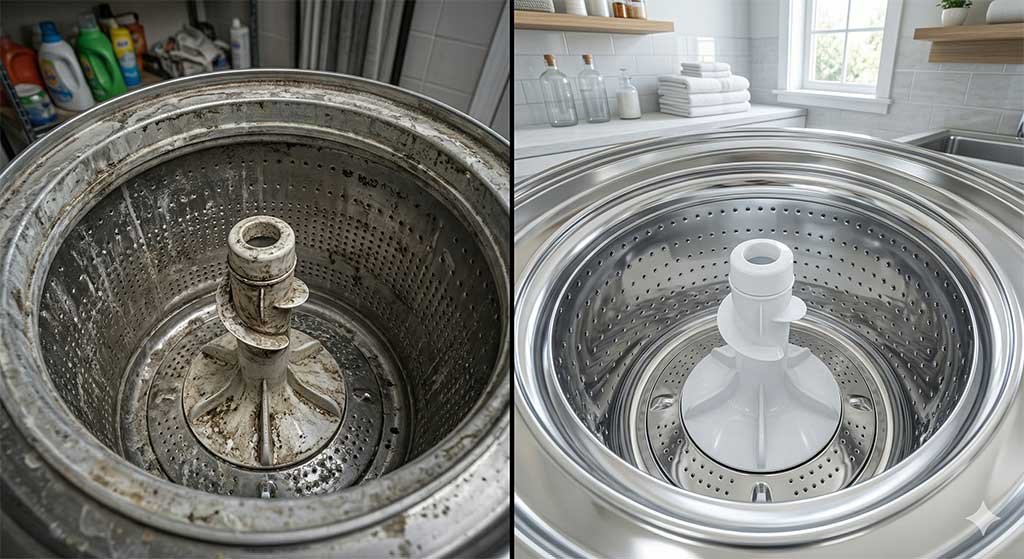
There is nothing quite as terrifying as the loud, violent banging noise echoing through your house during laundry day. When your machine starts shaking aggressively during the spin cycle, figuring out how to fix unbalanced top load washer problems becomes an immediate priority. Ignoring a violently shaking washer can cause severe damage to the drum, the motor, and even your laundry room floor.
Washing machines rely on a delicate center of gravity to spin heavy, wet clothes at high speeds safely. If that balance is thrown off, the internal tub will slam against the outer metal casing, creating that dreadful racket.
In this guide, we will provide a clear, step-by-step diagnostic process to troubleshoot the shaking and stabilize your machine. You will learn quick fixes and professional techniques to restore peace and quiet to your laundry routine.
Table of Contents
Why Does a Top Load Washer Become Unbalanced?
Top-loading washing machines are engineered to spin heavily saturated fabrics at incredibly fast speeds to extract water efficiently. To do this without self-destructing, the internal drum must maintain a perfect center of gravity. When this delicate balance is disrupted, the centrifugal force throws the heavy tub outward.
The most common culprit is simply user error, such as washing a single heavy item like a king-size comforter without counterweights. However, the machine settling on an uneven floor over time can also trigger the shaking. Worn-out internal suspension parts are another frequent cause that requires a closer inspection.
Tools You Will Need for the Fix
Before you start taking your washing machine apart, it is important to gather the right diagnostic and repair tools. Most of the early troubleshooting steps require nothing more than basic items you likely already have in your garage.
Here is your basic washer stabilization toolkit:
- A Bubble Level: Essential for checking if the machine is sitting perfectly flat on the floor.
- Adjustable Pliers: Needed to loosen and tighten the locking nuts on the washer’s leveling legs.
- An Old Towel: Protects your hands and the floor if you need to tip the heavy machine slightly.
- Replacement Suspension Rod Kit: Only necessary if your diagnostic tests reveal that the internal shock absorbers have failed.
Step-by-Step: How to Fix Unbalanced Top Load Washer
Troubleshooting a violently shaking washing machine is completely manageable when you follow a logical process. Work your way through these diagnostic steps, starting with the easiest solutions before attempting any mechanical repairs.
Step 1: Redistribute the Laundry Load (The Quick Fix)
The easiest and most common fix requires absolutely no tools at all. If the machine starts banging, immediately pause the cycle and open the lid to inspect the wet clothes. (Pro tip: If you notice a musty smell when you open that lid, it is also a great time to learn how to clean a large capacity top load washer). You will likely find a heavy, tangled ball of fabric pushed entirely to one side of the agitator.
Manually untangle the wet clothes and distribute them evenly around the center of the massive drum. If washing a single heavy blanket, add a few large towels to the opposite side to act as a counterweight. Close the lid and resume the spin cycle to see if the machine now operates smoothly.
Step 2: Check and Adjust the Leveling Legs
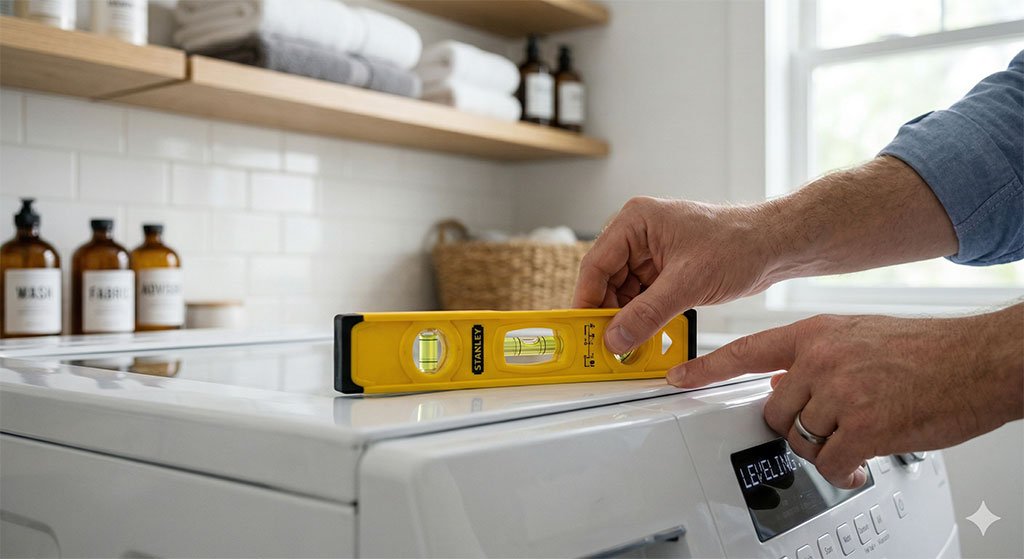
If the load is balanced but the machine still shakes, the appliance itself might be sitting on an uneven angle. Grab your bubble level and place it on the top edge of the washing machine, checking both side-to-side and front-to-back. The bubble must sit perfectly in the center of the glass vial to ensure stability.
If the machine is leaning, use your adjustable pliers to loosen the locking nuts on the front leveling legs. Turn the legs clockwise to lower the machine or counter-clockwise to raise it until the level shows a perfect balance. Once the machine is completely flat, tighten the locking nuts back against the base.
Step 3: Inspect the Washer’s Placement on the Floor
Sometimes the machine is perfectly level, but the floor underneath it is slick, damaged, or fundamentally uneven. A rotting subfloor or highly polished tiles can cause the washing machine to slowly “walk” out of place during vibrations. Over time, this movement pushes the machine into a tilted position, triggering the violent banging.
To prevent this walking, consider sliding thick, rubber anti-vibration pads under each of the four leveling legs. These pads grip the floor tightly and absorb the kinetic energy of the high-speed spin cycle. It is an incredibly cheap and effective way to anchor a wandering washing machine permanently.
Step 4: Examine the Snubber Ring or Dampening Straps
If the exterior is perfectly level, the problem lies deep within the washing machine’s internal suspension system. Older top-load washers rely on rubber dampening straps or a plastic snubber ring to cushion the tub during the spin cycle. These parts act exactly like the shock absorbers on your car.
Over years of heavy use, these rubber straps can stretch out, fray, or snap completely. The plastic snubber ring can also wear down, causing metal-on-metal grinding when the heavy tub shifts. If you open the front panel and see broken straps, replacing them will instantly stabilize the tub.
Step 5: Test the Suspension Rods (The Bounce Test)
Modern large-capacity washers use a set of four spring-loaded suspension rods to hold the massive drum in place. To test if these rods are failing, open the lid and press firmly down on the top edge of the plastic tub. Release your hands quickly and watch how the drum reacts to the sudden lack of pressure.
If the tub smoothly bounces back into place and stops moving, the suspension rods are still in good condition. If the tub continues to bounce up and down wildly like a basketball, the springs are completely shot. You will need to order a model-specific suspension rod kit to replace all four rods simultaneously.
When Is It Time to Replace Your Washing Machine?
While replacing a single dampening strap or leveling a leg is cheap, major internal repairs quickly become expensive. If your suspension rods, tub bearings, and snubber ring all need replacing at the same time, parts and labor add up fast. Often, these repair costs simply outweigh the actual value of an aging, inefficient appliance.
If your older machine refuses to stay balanced despite your best efforts, throwing money at it is a waste. It might be time to invest in a modern upgrade that can handle heavy loads without shaking your house apart. Check out these best large capacity top load washer reviews to find a stable, heavy-duty replacement.
FAQ
No, you should never let a violently shaking washing machine finish its cycle. The excessive kinetic force can dent the outer cabinet, shatter internal plastic components, and permanently damage the drive motor. It can also cause the machine to walk, potentially ripping the water hoses from the wall and flooding your home.
If you purchase the parts and perform the replacement yourself, a new set of suspension rods usually costs between $30 and $70. If you hire a professional appliance repair technician, expect to pay between $150 and $300 for parts and labor. Always replace all four rods at the same time to ensure even dampening.
Anti-vibration pads are excellent for stopping a leveled machine from sliding on a slick floor or vibrating loudly against joists. However, they will not fix an internally unbalanced machine that has broken suspension rods or a worn snubber ring. They treat the external symptoms of vibration, not the mechanical failure inside the cabinet.
Conclusion
Dealing with a noisy, shaking appliance is frustrating, but restoring peace to your laundry room is entirely possible. By systematically checking the load, leveling the legs, and testing the internal suspension, you can isolate the exact mechanical failure. Knowing how to fix unbalanced top load washer problems saves you from expensive service calls and prevents catastrophic water damage.
Always start with the simplest solutions, like redistributing a heavy blanket, before taking the cabinet apart. If your machine is simply too old and worn out to save, do not hesitate to upgrade to a more stable model. A smooth, quiet spin cycle will make your weekly laundry chores significantly less stressful.