Is your cleaning routine taking over your free time?
You are standing in the store aisle or scrolling through Amazon. You have a decision to make. On one hand, you see a sleek, futuristic disc that promises to clean your floors while you sleep. On the other, you see the trusty, powerful machine that has been a household staple for fifty years.
It is a classic battle: convenience versus raw power.
Choosing between a Robot vacuum cleaner vs normal vacuum is not just about buying a gadget. It is about choosing a lifestyle. Do you want to automate your chores? Or do you want the satisfaction of a deep, heavy-duty clean?
If you are confused, you are not alone. These devices have different strengths, different price tags, and very different results. This guide will walk you through every aspect of the debate. By the end, you will know exactly which machine belongs in your home.
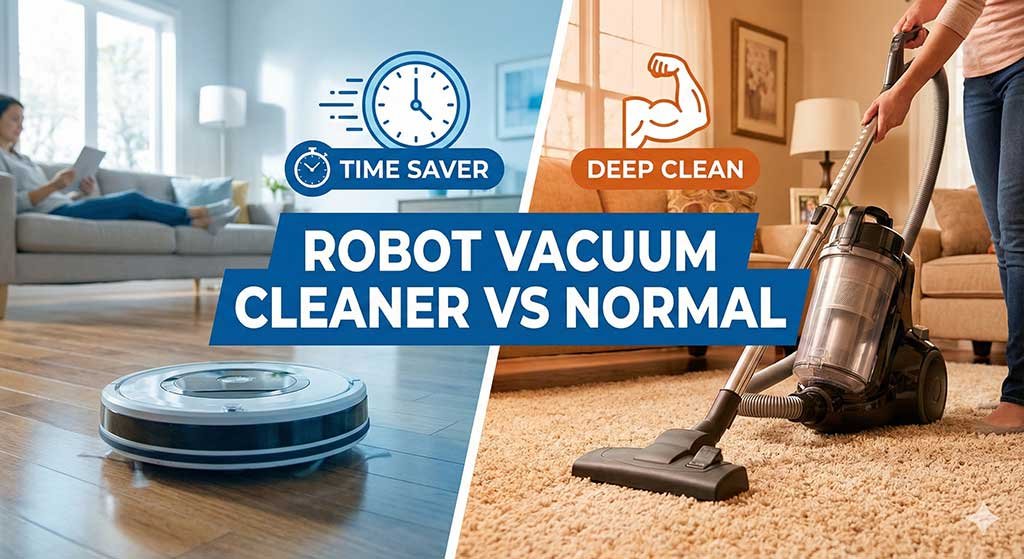
Table of Contents
Core Difference: Automation vs. Muscle
Before we dive into the details, let’s simplify the choice.
Robot vacuums are built for maintenance. They are “smart” sweepers. They are designed to run every single day. Their goal is to stop dust, crumbs, and pet hair from building up on your floors. They keep your house looking presentable 24/7 with zero effort from you.
Normal vacuums (whether upright, canister, or stick) are built for deep cleaning. They rely on massive motors plugged into the wall. They don’t just skim the surface; they pull dirt from the bottom of your carpet fibers.
Think of it this way:
- A Robot is like brushing your teeth. You do it every day to maintain health.
- A Normal Vacuum is like going to the dentist. It is the deep clean that resets everything.
1. Suction Power and Cleaning Performance
If you care about raw cleaning ability, this is the most important section.
The Physics of Normal Vacuums
You cannot beat physics. A normal vacuum usually plugs into an electrical outlet. This gives it a constant, powerful stream of energy.
- High Airflow: They generate massive airflow (measured in CFM). This lifts heavy debris like coins, cereal, or small rocks.
- Carpet Agitation: The heavy brush roll beats your carpet. This vibration loosens dust trapped deep in the fibers.
- The Result: One pass with a normal vacuum usually cleans 99% of the dirt in that path.
The Limitations of Robots
Robot vacuums run on batteries. To save energy, they have smaller motors.
- Surface Cleaning: They are fantastic at picking up surface dust, sand, and pet hair.
- Deep Carpet Issues: They struggle with high-pile carpets. They simply lack the suction to pull dirt out from deep down.
- The “Double Pass”: A robot might need to go over the same spot two or three times to get it as clean as a normal vacuum does in one pass.
Verdict: If you have wall-to-wall thick carpets, the Normal Vacuum wins easily. For hardwood and tile, the race is much closer.
2. Convenience Factor: Time is Money
How much is your Saturday morning worth to you? This is where the robot dominates.
The “Set It and Forget It” Lifestyle
Imagine this scenario: You leave for work at 8:00 AM. You open an app on your phone and hit “Clean.” When you return at 5:00 PM, your floors are spotless.
- Consistency: Because robots are effortless, you use them more often. Your floors stay consistently clean rather than getting dirty and waiting for “cleaning day.”
- Under Furniture: This is a hidden benefit. Robots are short. They slide under beds, sofas, and TV stands effortlessly. Normal vacuums require you to move heavy furniture to clean those spots.
The Manual Labor Reality
Using a normal vacuum is a workout.
- Physical Strain: You have to drag a 15-pound machine out of the closet. You have to plug it in, push it back and forth, and wrap the cord up when you are done.
- Time Sink: Vacuuming an average 3-bedroom house takes 45 to 60 minutes. That is an hour of your life every week. Over a year, that is 50 hours—more than a full work week—spent cleaning floors.
Verdict: The Robot Vacuum wins for convenience. It gives you your time back.
3. Intelligence and Navigation
This is where technology separates the two.
Normal Vacuums: You Are the Brain
A normal vacuum is a “dumb” tool. It relies on your eyes to see dirt. It relies on your hands to steer around obstacles. It will never get lost, but it requires your full attention. If you miss a spot, the vacuum misses a spot.
Robot Vacuums: Sensors and Lasers
Modern robots are engineering marvels.
- LiDAR Mapping: High-end models use lasers to draw a map of your house. You can tell them to “Clean the Kitchen” and skip the Living Room.
- Obstacle Avoidance: Some robots have cameras that see shoes, cables, and even pet waste. They steer around these hazards automatically.
- The “Dumb” Robots: Be careful with cheap models. Budget robots often use “bump and run” navigation. They bounce off walls randomly. This takes longer and often misses spots.
Verdict: Robot Vacuums are technologically superior, but they can get confused by dark rugs or mirrors. Normal vacuums are reliable because you are in control.
4. Versatility: Floor vs. Whole House
Your house is 3D, but a robot lives in a 2D world.
The Limitations of a Robot
- Floors Only: A robot cannot clean your curtains. It cannot clean the crumbs out of your sofa cushions. It definitely cannot clean the spiderwebs on the ceiling.
- Stairs: This is the kryptonite of robot vacuums. They have “cliff sensors” to stop them from falling, but they cannot climb or clean stairs. If you have a two-story home, you have to carry the robot up and down.
The Flexibility of a Normal Vacuum
A standard upright or canister vacuum is an all-in-one tool.
- Attachments: They come with crevice tools, dusting brushes, and upholstery tools.
- Car Cleaning: You can take a normal vacuum out to the garage to detail your car mats.
- Mattresses: You can use the hose to vacuum dust mites off your mattress.
Verdict: The Normal Vacuum is the clear winner for versatility. It cleans the whole house, not just the floor.
5. Maintenance and Durability
Every machine needs love. Which one is higher maintenance?
Living with a Robot
Ironically, the device meant to save labor requires a fair bit of babysitting.
- Small Bins: The dustbin is tiny (usually 0.4 liters). Unless you buy a model that empties itself (which is expensive), you must empty it after every run.
- Hair Tangles: Robot brushes are smaller. Long human hair or pet fur wraps around them tightly. You will need to cut this hair away regularly.
- Preparation: You must “robot-proof” your home. You cannot leave socks, phone chargers, or Lego bricks on the floor. If you do, the robot will eat them and choke.
Living with a Normal Vacuum
- Huge Capacity: Bagged vacuums can hold months’ worth of dirt. Bagless bins hold liters at a time.
- Durability: These machines are tanks. They are built to take a beating. A good upright vacuum can last 10 to 15 years.
- Batteries: Robots run on lithium batteries. Like your phone, these degrade. After 3 or 4 years, the robot might not hold a charge, requiring a pricey battery replacement.
Verdict: Normal Vacuums are more durable and require less frequent maintenance.
6. Cost Breakdown
Let’s talk dollars and cents.
Upfront Costs
- Budget Robot: $150 – $300. (Random navigation, low suction).
- Premium Robot: $500 – $1,200. (Self-emptying, laser mapping, AI cameras).
- Budget Normal Vacuum: $60 – $150. (Basic suction, corded).
- Premium Normal Vacuum: $200 – $600. (Dyson, Shark, Miele quality).
The Value Equation
You get more “cleaning power per dollar” with a normal vacuum. A $150 upright vacuum will clean carpets better than a $1,000 robot. You are paying the extra money for the software and automation, not the suction.
Comparison Chart: Robot Vacuum Cleaner Vs Normal
Here is a quick snapshot to help you decide.
Feature | Robot Vacuum Cleaner | Normal Vacuum (Upright/Canister) |
Cleaning Power | Light to Moderate | Heavy Duty / Deep Clean |
Best Surface | Hardwood, Tile, Low Pile Rugs | Thick Carpets, Rugs, All Floors |
User Effort | 5% (Empty bin/maintenance) | 100% (Manual pushing) |
Cleaning Speed | Slow (45-90 mins) | Fast (Depends on you) |
Stair Cleaning | Impossible | Easy (with attachments) |
Noise Level | Quiet (Conversation level) | Loud (Can scare pets) |
Lifespan | 3 – 5 Years | 10 – 15 Years |
Initial Cost | High for good performance | Low for good performance |
Who Should Buy What? (Scenario Check)
Still undecided? Find your profile below.
Profile A: The Pet Owner
- You need: Both (or a high-end Robot).
- Why: Pets shed constantly. A robot running daily keeps the fur tumbleweeds under control. However, you still need a normal vacuum for the deep fur stuck in the rugs.
Profile B: The Busy Parent
- You need: Robot Vacuum.
- Why: You don’t have time to vacuum. Even a “pretty good” clean from a robot is better than a dirty floor because you are too tired to clean. Just make sure the floor is clear of toys first!
Profile C: The Allergy Sufferer
- You need: Normal Vacuum (HEPA Bagged).
- Why: You need a sealed system. Robots blow exhaust air right at floor level, which can sometimes kick up dust. A bagged normal vacuum with a HEPA filter captures 99.97% of allergens and keeps them locked away.
Profile D: The Budget Shopper
- You need: Normal Vacuum.
- Why: A cheap robot is frustrating. It gets stuck and misses spots. A cheap normal vacuum still sucks up dirt effectively.
FAQ
For 80% of people, the answer is no. Think of a robot as a helper, not a replacement. It maintains cleanliness during the week. However, you will likely still need a manual vacuum for stairs, deep carpet cleaning, and upholstery.
Generally, they are safe. Most use rubber wheels and soft side brushes. However, you must check the wheels regularly. If a piece of grit or a sharp pebble gets stuck in the wheel, the robot could drag it around and scratch the finish.
Rarely. Almost all modern robots have “cliff sensors.” These infrared sensors detect a drop-off and tell the robot to reverse. However, these sensors can get dirty, so you should wipe them clean once a month to ensure safety.
Run it daily. This is the secret to success. Since they have lower power, they rely on frequency. If you run it every day, dirt never has a chance to settle deep into the carpet or accumulate in corners.
The biggest downside is preparation. You cannot just press a button if your floor is messy. You have to pick up socks, cables, and clutter first. If your house is naturally messy or cluttered, a robot might be more frustration than it is worth.
Final Words
So, who wins the Robot vacuum cleaner vs normal showdown?
It comes down to your priorities. If you want pristine carpets and don’t mind the physical work, the normal vacuum is the undisputed king of power and value. It is reliable, versatile, and tough.
However, if you are busy and value your free time above all else, the robot vacuum is a life-changer. It won’t clean as deep, but it cleans more often, keeping your home consistently tidy.
For the ultimate clean home, the best solution is actually a team effort: let the robot handle the daily dust, and bring out the normal vacuum for a monthly deep clean.