Have you ever been startled by a sudden, rhythmic thumping coming from your laundry room? You put a heavy comforter in to get it clean. Now, your appliance is dancing across the floor and vibrating the entire house. If you have a washing machine shaking when washing blankets, you are dealing with one of the most common and annoying laundry problems.
It starts with a soft knock. Then, it turns into a violent shudder during the spin cycle. You might even find your washer inches away from where it started. Blankets are uniquely difficult for home appliances. They are large, absorbent, and very heavy when wet.
If you do not handle this weight correctly, your machine’s suspension system simply cannot keep up with the force. In this guide, we will explore why this happens and how you can stop the shaking for good.
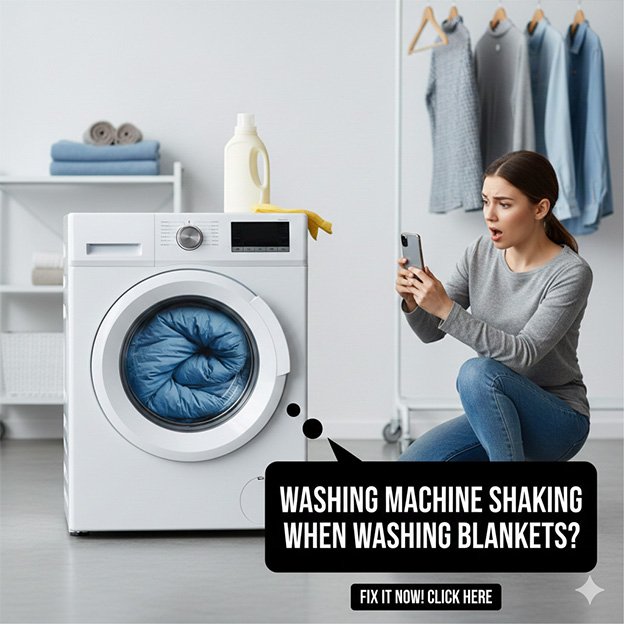
Table of Contents
Why Blankets Cause Such Intense Shaking?
When you wash a standard load of t-shirts or towels, the weight is distributed across many small items. Blankets are different because they are one single, massive piece of fabric. A king-size comforter or a thick wool blanket can absorb gallons of water. This creates a “ball” of weight that is difficult for the drum to balance.
If that blanket ends up on one side of the drum, the machine becomes unbalanced. During the high-speed spin cycle, centrifugal force pulls that weight outward. This causes the tub to hit the cabinet walls with incredible force. This is the source of that “bang-bang-bang” sound you hear.
The Impact of Different Fabrics
Not all blankets are created equal. Some hold more water than others, leading to more vibration.
- Cotton Comforters: These act like sponges. They become incredibly dense and heavy.
- Wool Blankets: Wool is heavy to begin with. When wet, it is one of the hardest things for a washer to spin.
- Fleece and Synthetic: These tend to shed water faster but can still bunch up into a tight knot.
- Weighted Blankets: Most home washers are not built for these. They can snap suspension rods instantly.
Machine Types: Top Load vs. Front Load
Your experience with a washing machine shaking when washing blankets often depends on the type of machine you own.
Top-Loading Washers
These machines use a vertical tub. In older models with an agitator, the blanket can get wrapped around the center post. This pulls the tub to one side. Newer High-Efficiency (HE) top loaders do not have an agitator. Instead, they use an impeller at the bottom. While they have more space, they are very sensitive to how you lay the blanket inside. If the blanket is not level, the tub will tilt and hit the sides.
Front-Loading Washers
Front loaders handle large blankets better because the fabric falls and redistributes as it spins. However, if the blanket is too large for the drum, it cannot tumble. To avoid this, you should check if your specific drum size can handle a comforter before starting the cycle. If the bedding stays stuck in one position, it will cause the entire machine to rock back and forth.
Immediate Steps to Stop the Shaking
If your machine is shaking violently right now, do not let it finish the cycle. Excessive vibration can crack the outer tub or fry the electronic control board. Follow these steps:
- Hit the Pause Button: Stop the cycle immediately. Do not just wait for it to end.
- Wait for the Door to Unlock: Give the machine a moment to release the safety lock.
- Open the Lid and Redistribute: Reach in and feel the blanket. Is it all on one side? Is it wrapped into a tight ball?
- Spread it Out: Spread the blanket as evenly as possible around the perimeter of the drum.
- Add a Counter-Weight: If you are only washing one blanket, add two large, heavy towels. Place them on the opposite side of the blanket to help balance the weight.
- Switch to a Lower Spin Speed: If your machine has a “Low” or “No Spin” option, use it to get through the current load safely.
Professional Loading Techniques
Preventing a washing machine shaking when washing blankets starts before you even press the start button. Proper loading is an art form.
The Accordion Method
Instead of stuffing the blanket in or wrapping it in a circle, fold it back and forth like an accordion. Place this “stack” into the machine. This allows the water to penetrate the folds evenly and helps the blanket expand against the drum walls during the spin cycle.
The “Doughnut” Rule
For top-loading machines, never wrap the blanket tightly around the agitator. This creates a “ring” that can become a solid mass of weight. Drop the blanket in loosely and ensure it sits level at the bottom.
Check the Capacity
Your washer has a weight limit. Look at your owner’s manual. A standard 4.5 cubic foot washer can usually handle a queen-size comforter. A king-size comforter often requires a 5.0 cubic foot machine or larger. If you frequently wash heavy bedding, you may want to invest in a high-capacity washer built for heavy-duty loads to prevent long-term damage to your suspension system. Remember: if the blanket fills more than 75% of the drum while dry, it is too big for your home machine.
Diagnose Mechanical Issues
Sometimes the blanket is not the only problem. If your machine shakes with every load, or if it has started shaking more than it used to, you may have a mechanical failure.
1. Leveling the Feet
This is the most common cause of “walking” washers. If one foot is slightly shorter than the others, the machine will rock. Use a bubble level to check the top of the machine from front to back and left to right.
- The Fix: Use a wrench to adjust the feet. Extend them until they all touch the floor firmly. Tighten the lock nuts to ensure they do not move during a cycle.
2. Suspension Rods (Top Loaders)
Inside a top loader, the tub is suspended by four metal rods with springs. These rods absorb the movement of the tub. Over time, the grease on these rods dries out, or the springs lose their tension.
- The Test: Open the lid and push the tub down hard. It should bounce once and stop. If it continues to bounce like a pogo stick, your suspension rods are “shot” and must be replaced.
3. Shock Absorbers (Front Loaders)
Front-loading washers have shock absorbers at the bottom of the drum. These work just like the shocks on your car. If they leak oil or become soft, the drum will slam into the cabinet. You will hear a loud “clunking” sound every time the drum rotates.
Component | Main Job | How it Fails |
Leveling Feet | Keeps the frame stable | Loosens or becomes uneven |
Suspension Rods | Holds the tub in place | Springs weaken or snap |
Shock Absorbers | Dampens drum motion | Fluid leaks or internal wear |
Balance Ring | Offsets weight with fluid | Fluid leaks out of the ring |
Shipping Bolts | Holds drum during move | Left inside after installation |
The Role of Your Home’s Flooring
We often blame the machine, but sometimes the floor is the culprit. If your laundry room is on the second floor, the wooden joists may be flexing. When the machine spins, the floor acts like a drum, magnifying the vibration.
Concrete Floors: These are the best for washers. They are rigid and do not vibrate.
Wooden Joists: If your floor is bouncy, you may need to reinforce it. Placing a 3/4-inch piece of marine-grade plywood under the washer and dryer can help. This spreads the weight across more floor joists and reduces the “trampoline” effect.
External Tools and Stabilizers
If your machine is mechanically sound but still vibrates, you can use external tools to quiet the noise.
- Anti-Vibration Pads: These are thick rubber cups that go under each foot. They are designed to absorb energy and keep the machine from “walking” across the floor.
- Heavy-Duty Rubber Mats: A thick mat (like the ones used in horse stalls) can be placed under the entire machine. This is very effective for concrete basement floors.
- Pedestal Checks: If your front loader is on a pedestal drawer, make sure the drawer is closed tightly. A loose pedestal can act as a sounding board and make the shaking much louder.
Regular Maintenance for Heavy Loaders
If you wash blankets frequently, you need to perform extra maintenance. Heavy loads put stress on the drive belt and the motor.
- Check for Leaks: A small leak can make the floor slippery, causing the machine to slide.
- Clean the Drum: Use a washing machine cleaner monthly. This removes soap scum that can make the interior drum slippery and cause the load to bunch up.
- Inspect the Belt: If you have a belt-driven machine, a worn belt can slip during heavy loads, leading to jerky movements.
- Tighten the Bolts: Every six months, check that the motor and pulley bolts are tight. Vibration can slowly unscrew them.
FAQ
It depends on your washer’s capacity. If the comforter fits easily and leaves a little room, it is safe. If you have to shove it in with force, you should take it to a laundromat. Using a machine that is too small will wear out the bearings and drive system very quickly.
The spin cycle is when the drum reaches its highest speed (RPM). Centrifugal force is at its peak. Any slight imbalance in the weight distribution is magnified. At slow wash speeds, the machine can handle the imbalance, but at high speeds, the physics take over.
No. A rug is too soft and can actually make the machine less stable. It can also trap moisture, leading to mold and floor rot. Use specialized rubber anti-vibration pads or a solid plywood board instead.
If your machine sounds like a jet engine taking off, your bearings are likely failing. Bad bearings create a high-pitched roar or a grinding sound. If the bearings are loose, the drum will wobble, making it impossible to balance a heavy blanket.
Not directly. However, very hot water can make certain synthetic fibers heavier or more prone to tangling. Always follow the care label on the blanket. A tangled blanket is much harder to balance than a loose one.
Conclusion
Preventing a washing machine shaking when washing blankets requires a mix of proper loading and regular maintenance. Ensure your machine is level and avoid overloading the drum. If the vibration continues, check your suspension rods or shock absorbers for wear. Taking these small steps will protect your appliance and keep your home quiet during laundry day.