
If you have sensitive skin, your morning routine probably feels less like grooming and more like damage control. You know the drill: the redness, the stinging, the bumps that pop up two hours later, and the dread of having to do it all again tomorrow.
You’re probably wondering, are foil shavers good for sensitive skin? Or is this just another expensive gadget that will end up gathering dust in your bathroom cabinet?
The short answer is yes. Foil shavers are widely considered the “gold standard” for preventing irritation. Unlike rotary shavers that scrub your face in circles, or manual razors that scrape off layers of skin cells, foil shavers use a micro-thin protective barrier to keep the sharp blades away from your face.
If you are looking for the best electric razor for sensitive skin, understanding why foil technology works better is the first step to a pain-free shave.
Table of Contents
How Foil Shavers Work (The Skin Guard Mechanism)
To understand why foil shavers are safer for your skin, you have to look at what’s happening under the hood.
Imagine a cheese grater. (Stay with me here). If you run your hand over a cheese grater, you might get a few scrapes. Now, imagine putting a smooth, thin sheet of metal over that grater with tiny little holes in it. You can run your hand over it all day, and you won’t get cut.
That is essentially how a foil shaver works.
The Oscillating Blade
Inside the head of the shaver, there are blades moving back and forth at incredibly high speeds—sometimes up to 14,000 cycles per minute (like in Panasonic models) or 10,000 (like in Braun models). If these blades touched your skin directly, they would slice you open instantly.
The Foil Barrier
This is the magic part. Covering those manic blades is a thin, perforated sheet of metal called the foil. The holes in the foil are designed to capture your hair.
When you glide the shaver over your face, your skin rests against the smooth metal foil. Your beard hairs poke through the holes, and the oscillating blades underneath snip them off like a pair of hyper-fast scissors.
Why this matters for sensitivity: The blade never touches your skin. It cuts the hair, but the foil physically blocks the blade from scraping your epidermis (the top layer of your skin). This is a massive advantage over manual razors, which exfoliate your skin whether you want them to or not.
Foil vs Rotary for Sensitive Skin: Which is Better?
You’ll see two main types of electric razors on the shelf: Foil (straight heads) and Rotary (three circular heads). When comparing foil vs rotary for sensitive skin, the winner is clear.
Rotary shavers work by spinning in circles. To use them, you have to rub them on your face in circular motions. For men with tough skin or thick, swirling beards, this is fine. But if you have sensitive skin, that circular rubbing motion creates friction and heat—two things that guarantee razor burn.
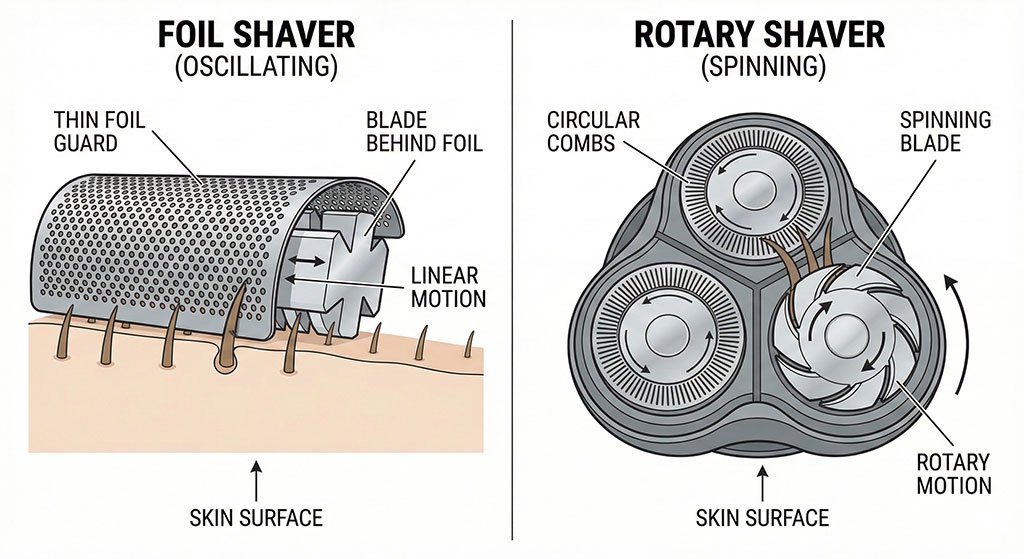
Here is a quick breakdown of how they compare specifically for sensitivity:
Feature | Foil Shaver | Rotary Shaver |
Motion | Linear (Back and Forth) | Circular (Rubbing/Scrubbing) |
Blade Contact | Shielded by foil mesh | Behind combs (often lifts hair) |
Friction Level | Low (Smooth glide) | High (Circular friction) |
Best For | Daily shaving, fine hair, sensitive skin | Long hair, contours, tough skin |
Risk of Irritation | Low | Moderate to High |
The Verdict: If your priority is comfort and avoiding redness, the linear, straight-line motion of a foil shaver is far superior to the “scrubbing” motion of a rotary.
Why Are Foil Shavers Good for Sensitive Skin? (3 Key Benefits)
So, we know the mechanism is safer. But specifically, are foil shavers good for sensitive skin in practice? Yes, and here are the three biggest reasons why you will feel the difference immediately.
1. Significantly Less Friction
Heat is the enemy. When you drag a razor across your face, you generate friction. Friction causes heat, and heat causes inflammation (redness).
Foil shavers—especially high-end ones from brands like Braun or Panasonic—are designed to stay cool. Because you are moving in straight lines rather than scrubbing circles, you aren’t generating unnecessary heat on your cheeks and neck. The smooth metal foil glides over the skin, acting almost like a cooling element.
2. No Hysteresis (The Pulling Effect)
Many rotary shavers and multi-blade manual razors use a technique called “hysteresis.” This is fancy marketing speak for “lift and cut.” The first blade pulls the hair out of the follicle, and the second blade cuts it.
While this gives a super close shave, it often cuts the hair beneath the skin level. When the hair snaps back down, it gets trapped under the skin, leading to—you guessed it—ingrown hairs.
Foil shavers generally don’t lift the hair. They cut what pokes through the foil. This means you get a shave that is “close enough” to look smooth, but not so close that you’re burying hairs under your skin.
3. You Don’t Need Pressure
This is the hardest habit to break. With a manual razor, you often feel like you need to press down to get that close shave.
With a good foil shaver, the machine does the work. In fact, if you press hard with a foil shaver, you ruin the shave. Pressing hard pushes your skin into the mesh holes, which leads to irritation. The design forces you to use a light touch, which is inherently better for sensitive skin.
Potential Drawbacks of Foil Shaver (Balanced View)
I want to be honest with you—foil shavers aren’t perfect. If they were, nobody would buy anything else. Even the best foil shaver for irritation has downsides you need to be aware of before you drop $200 on a new gadget.
- The Jawline Problem: Your face isn’t a flat sheet of paper; it has curves, specifically around your jaw and chin. Foil shavers are straight. Trying to shave a curved jaw with a straight bar can be tricky. You will need to stretch your skin and maneuver the shaver more than you would with a flexible rotary head.
- They Are Loud: Because the blades are vibrating back and forth at thousands of RPMs, foil shavers buzz. Loudly. It sounds like an angry hornet. If you value a peaceful, silent morning, this might be a shock.
- Daily Maintenance: Foil shavers struggle with long hair. If you skip shaving for 3 or 4 days and try to use a foil shaver on a mini-beard, it will likely tug and pull. They are designed for stubble. If you have sensitive skin, you really need to use it every day or every other day.
How to Shave with a Foil Shaver for Sensitive Skin (Step-by-Step)
You can have the best shaver in the world, but if you use it like a manual razor, you’re going to have a bad time. Here are the essential shaving tips for sensitive skin when using a foil shaver.
Step 1: The Prep
Your face needs to be dry. I know, manual shaving is all about “wet and warm,” but for most electric foil shavers, dry and cool creates less friction.
- Wash your face to remove oil (oil makes the foil drag).
- Wait 15 minutes for your face to dry completely.
- Optional: Use a “Pre-Shave” electric lotion (like Lectric Shave or Afta). These stand the hairs up and create a slick surface for the foil to glide on.
Step 2: The Angle
Hold the shaver at a strictly 90-degree angle (perpendicular) to your skin. You want the foil to be flat against your face, not tilted on one edge.
Step 3: The Motion
Shave against the grain.
This is the opposite of manual shaving! With a blade, you go with the grain to avoid cuts. With a foil shaver, you must go against the grain so the hair is forced into the little holes in the foil. Use short, fast, straight strokes. Do not go in circles.
Step 4: The Golden Rule (No Pressure)
I cannot stress this enough: Do not press down. Let the weight of the shaver do the work. If you hear the motor pitch drop, you are pressing too hard. Gliding is the goal.
Step 5: Post-Shave Care
Rinse your face with cold water to close the pores. Then, apply a high-quality, alcohol-free aftershave balm. Alcohol dries out sensitive skin; look for ingredients like Aloe Vera, Witch Hazel, or Tea Tree Oil.
FAQ
Maybe. You need to check if your specific model is “Wet/Dry” certified. Most modern Panasonic and Braun shavers are waterproof and work great with shaving cream. Using foam can add an extra layer of protection for super-sensitive skin, but it makes cleaning the shaver messier.
They are much less likely to cause ingrown hairs than rotary shavers or manual blades. Because they don’t lift the hair before cutting, the hair stays slightly above the skin line, preventing it from growing back inwards.
For sensitive skin, this is critical. You should replace the foil and cutter block every 12 to 18 months. A dull foil can get small dents or tears in the metal mesh. If you drag a torn mesh across your face, it will scratch you like a serrated knife. If your shaver starts “tugging” or feeling hot, change the head immediately.
While preferences vary, Braun (specifically the Series 7 and Series 9) is generally regarded as the most comfortable and gentle. Panasonic (Arc 5) is known for being sharper and closer, but sometimes slightly more aggressive.
Conclusion
So, are foil shavers good for sensitive skin?
Absolutely. In fact, for most men dealing with razor bumps and irritation, switching to a decent foil shaver is the single best change you can make. It removes the two biggest causes of irritation: direct blade contact and skin scraping.
It might take your skin two or three weeks to adjust to the new method (this is a real thing—don’t give up after day 3!), but once your skin adapts, you will likely find that the redness disappears.
If you are tired of dreading your morning shave, put down the multi-blade cartridge razor and give a foil shaver a try. Your face will thank you.