
Let’s be honest: standing in the grooming aisle (or scrolling through Amazon) staring at fifty different electric shavers is overwhelming. You see terms like “lift and cut,” “multi-flex heads,” and “turbo mode,” and suddenly, a simple hygiene purchase feels like buying a used car.
If you have been eyeing those razors with the three circular heads, you are looking at a rotary shaver. They are the most popular type of electric razor globally, largely thanks to Philips Norelco, but are they right for your specific beard and skin type?
Buying the wrong shaver isn’t just a waste of money, it’s a recipe for razor burn and a patchy morning look. That is why understanding the specific rotary shaver pros and cons is crucial before you click Add to Cart.
In this guide, I’m going to break down exactly how these machines work, why some men swear by them (while others hate them), and help you decide if a rotary shaver belongs in your bathroom cabinet.
Table of Contents
What Exactly Is a Rotary Shaver? (The Mechanics)
Before we dive into the good and the bad, we need to understand the mechanics. If you know how the engine works, you’ll know how to drive the car.
A rotary shaver typically features three (sometimes four) circular heads set in a triangular formation. Beneath the metal guards, circular blades spin at high speeds.
Unlike a foil shaver, which uses a straight, oscillating back-and-forth motion (like a lawnmower), a rotary shaver is designed to follow the contours of your face. You use it in a circular motion.
The metal guards on the heads have slots and holes designed to catch hair entering from all directions. This is a key distinction: foil shavers need hair to be standing straight up, but rotary shavers are hunters—they go out and find the hair, even if it’s lying flat against your neck.
Pros of Rotary Shavers
There is a reason why brands like Philips Norelco dominate the market. For about 50% of the male population, a rotary shaver is simply the superior tool. Here is why.
1. Superior Contouring and Flexibility
This is the rotary shaver’s superpower. Because the three heads usually move independently (often called 3D or 360-degree flex), the shaver can hug the curves of your face much better than a straight foil bar can.
If you have a sharp jawline, a prominent chin, or a distinct Adam’s apple, a rotary shaver flows over these obstacles like water. You don’t have to manipulate your wrist at awkward angles to get the blade to touch your skin. The shaver does the acrobatic work for you.
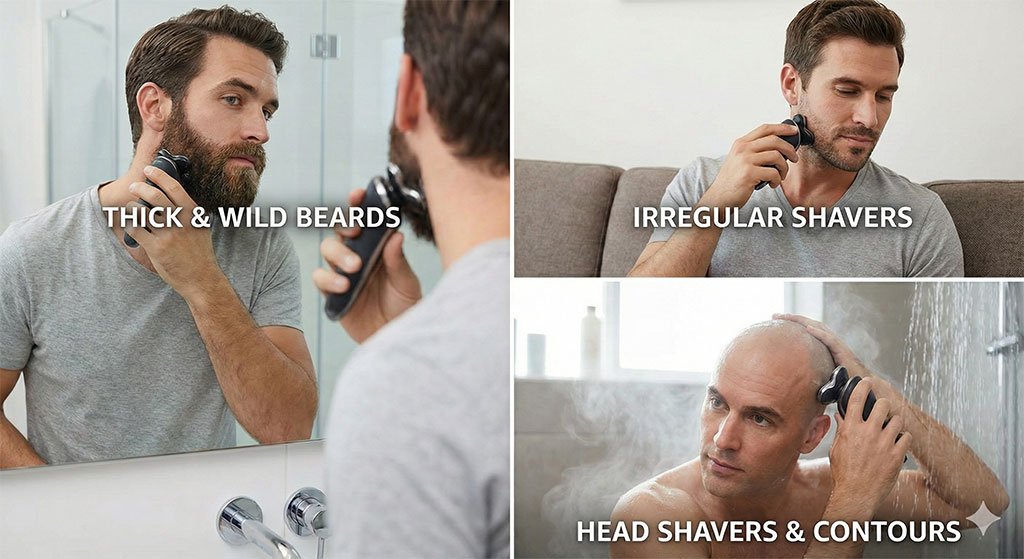
2. It Handles Long, Thick, and Wild Hair
Do you have a beard where the grain grows in five different directions? This is called a “whorl,” and it is a nightmare for most razors.
Foil shavers require you to shave against the grain in straight lines. If your grain changes direction on your neck (which it almost always does), a foil shaver will miss those hairs.
A rotary shaver, however, uses a circular motion. This means you are hitting the hair from every possible angle—North, South, East, and West—in a single pass. The slots in the rotary heads are also generally wider, allowing them to capture thick, coarse, and curly hair much easier than the mesh foil screens.
3. The Lazy Man’s Best Friend (Irregular Shaving)
I say this with love: if you are the type of guy who doesn’t shave every single morning, a rotary is your best bet.
Foil shavers struggle with hair that is longer than a day or two of growth. If you skip shaving on Saturday and Sunday, a foil shaver might tug and pull on Monday morning because the long hairs can’t poke through the mesh.
Rotary shavers are excellent at mowing down 3-day or even 4-day stubble. They are designed to tackle longer growth without yanking the hair out of your face, making them the perfect choice for the “weekend warrior.”
4. Extremely Quiet Operation
If you wake up at 5:00 AM and don’t want to wake the baby (or your partner), get a rotary.
Foil shavers operate at a very high frequency (10,000+ micro-vibrations per minute), creating a loud, high-pitched buzzing sound—think of an angry mosquito. Rotary shavers spin at a lower RPM. They produce a low, quiet hum that is much easier on the ears early in the morning.
5. Durability of Blades
Rotary blades are generally thicker and more robust than the delicate, paper-thin screens found on foil shavers. While you should still change them every 12 to 24 months, they tend to hold their edge longer and are less prone to denting if you accidentally drop the shaver in the sink.
Cons of Rotary Shavers
To provide a fair rotary shaver pros and cons analysis, we have to look at the downsides. These devices are not perfect, and for some men, they can actually be a downgrade from a manual razor.
1. Skin Irritation (The Rotary Burn)
This is the biggest complaint I hear from new users. Because you have to move the shaver in circular motions, you are inevitably going over the same patch of skin multiple times, overlapping your strokes.
For men with sensitive skin, this friction can cause redness and razor burn, especially on the neck. Unlike a foil shaver, which is generally gentler and requires fewer passes, a rotary shaver demands a bit more contact time with the skin to catch all the hairs.
2. It’s Not a Baby Butt Smooth Shave
If you are a perfectionist who wants a shave so close that you can’t feel a single stubble when you rub your cheek against the grain, a rotary shaver might disappoint you.
The metal guards on a rotary shaver are thicker than the mesh on a foil shaver. This creates a physical barrier between the blade and your skin. While modern high-end rotaries (like the Norelco 9000 Prestige) get very close, they generally cannot match the closeness of a high-end foil shaver (like the Braun Series 9) or a manual safety razor.
3. The Learning Curve
If you have spent your whole life using a Gillette Fusion or a Mach 3, your muscle memory is trained to use straight, up-and-down strokes.
When you switch to a rotary, you must use circular motions. If you use straight strokes with a rotary shaver, it will perform poorly and pull your hair. It can take 2 to 3 weeks for your hand to get used to the motion and for your skin to adjust to the new shaving method. Many users give up after week one, thinking the shaver is “junk,” when really, it’s just a technique issue.
4. Cleaning Can Be Tricky
While newer models come with cleaning stations, manual cleaning can be annoying on budget rotary models.
On some older or cheaper units, you have to pop the head open, unlock a retaining ring, and take out each of the three cutters individually to clean out the hair chamber. If you lose one of those tiny retaining rings down the drain, your shaver is useless. (Pro tip: Always plug the sink before cleaning!).
Rotary vs. Foil Shaver: The Verdict
To make this easy to scan, let’s break down the differences directly.
Feature | Rotary Shaver | Foil Shaver |
Cutting Motion | Circular (Spinning) | Linear (Oscillating) |
Best For | Tough skin, thick/coarse hair, irregular shaving | Sensitive skin, fine hair, daily shaving |
Noise Level | Quiet Hum | Loud Buzz |
Close Shave? | Good (Adequate for most) | Excellent (Closest electric shave) |
Contouring | High (Great for jawlines/heads) | Low (Better for flat surfaces/cheeks) |
Maintenance | Blades last 12-24 months | Foils last 12-18 months |
Who Should Buy a Rotary Shaver?
Based on the rotary shaver pros and cons above, let’s identify exactly who this tool is for. You should buy a rotary shaver if:
- The “Roughneck”: You have coarse, thick hair that grows in swirls and different directions.
- The Irregular Shaver: You don’t shave every day. You often have 3 or 4 days of stubble when you decide to clean up.
- The Head Shaver: If you shave your bald head, rotary is king. Your skull is one big curve, and the flexible rotary heads adapt to the shape of your head much better than a flat foil shaver.
- The Quiet Type: You hate the loud buzzing noise of standard electric razors.
You should AVOID a rotary shaver if:
- You have extremely sensitive skin that turns red easily.
- You require a glass-smooth finish for professional reasons or personal preference.
- You shave religiously every single morning (a foil is faster for daily stubble).
Maintenance: Keeping Your Rotary Spinning
If you decide to take the plunge, you want that investment to last. Because rotary shavers rely on spinning gears, maintenance is key.
- Lubrication is Life: Even if your shaver says it’s “self-sharpening,” use a drop of clipper oil or spray lubricant on the heads once a week. This reduces friction and heat, which is the main cause of skin irritation.
- The Deep Clean: Once a month, fully disassemble the head (consult your manual). Hair dust mixes with skin oils to create a “sludge” that can slow down the motor.
- Replace the Heads: Don’t wait until it hurts. If you feel the shaver pulling hairs instead of cutting them, the blades are dull. For most brands, this happens around the 12-month mark.
FAQ
They can. Because of the “lift and cut” technology used in many rotary shavers (where the first blade lifts the hair and the second cuts it), the hair can sometimes be cut slightly below the skin line. When it grows back, it may become trapped. If you are prone to ingrowns, wash your face with warm water before shaving to soften the skin.
Yes! Most modern rotary shavers are “Wet/Dry” compatible. Using a high-quality shaving cream or gel can significantly reduce the friction and irritation we mentioned in the “Cons” section. Just make sure to rinse the head thoroughly afterward.
They are certainly the market leader and generally have the best technology. However, Remington makes solid budget-friendly rotary shavers. But generally speaking, in the rotary world, Philips is the gold standard.
Conclusion
So, is a rotary razor right for you?
We have weighed the rotary shaver pros and cons, and the decision ultimately comes down to your beard density and your shaving habits.
If you are a guy with thick, wild facial hair who hates shaving every day and wants a quiet, durable machine that can navigate a sharp jawline—the rotary shaver is your perfect match. It handles the “heavy lifting” of grooming better than any other tool.
However, if you have sensitive skin and demand a barber-close finish every single morning, you might be better off sticking with a foil shaver.